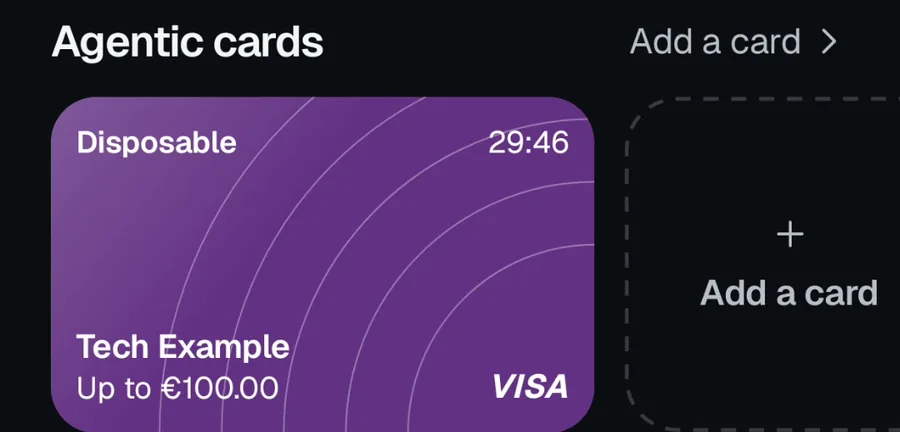
Cards under each agent
Each card has its own shop and its own ceiling. Add more cards at any time.
Built on the Machine Payments framework. Each AI agent gets its own small account under your name, and the bank issues card numbers only against a task you gave. Each number works at one shop, up to one ceiling. The agent can pay, and it never holds your keys.
A preview of the product. It is not yet available.
No task means no number. A page can talk a model into wanting something, but it cannot forge an instruction you never gave.
The agent pays under your checked identity, from its own pot. It has its own key, and it never sees your card or your login.
Your caps, categories and approvals run at the bank, on every payment. The agent cannot argue with them, and no shop changes anything.
Travel agent
€426.00 in the pot
Your task: “book flights, under 200, by Friday”
Try it at the demo shop
This card works at one shop, up to one ceiling. It dies after one purchase or in 30 minutes.
Each agent gets its own  pot under your name, a
 card locked to one shop, and your
 hold above the line you set.
“book flights, under 200, by Friday”
You give the agent one task, in your own words.
The bank turns it into one number, locked to one shop and one ceiling.
A card payment carries very little: a shop, an amount and a kind of shop. It cannot carry a sentence like "book flights under 200". With an ordinary card, that leaves two poor choices. You trust the agent with everything, or you approve every purchase yourself.
Machine Payments moves the check. The bank reads your instruction first, then issues a number locked to it. The number carries your instruction to the shop, on the card rails that shops already use.
| Your own card in an agent's hands | An agent with Machine Payments | |
|---|---|---|
| Who the bank sees | You. The agent is invisible. | An agent, with a real customer's identity behind it. |
| What it can spend | Everything the card can reach. | Only what is in its pot, inside your caps. |
| Where the number works | Any shop that takes the card. | One shop, up to one ceiling, for minutes. |
| A page tricks the agent | The agent has what it needs to pay. | No task means no number, and nothing to pay with. |
| The number leaks | It works until you cancel your card. | A used number is dead. A wrong shop burns it for good. |
| A payment fails | A vague decline. The agent retries or gives up. | A reason code and the data to act on it. |
| Something feels wrong | You cancel the card you use every day. | One hold freezes every agent. Your own cards keep working. |
| A dispute starts | Your word against the shop's. | Three lines to read: your task, the payment, the shop's confirmation. |
One owner, from the first deposit to the final record: money in, a new agent, a card, a payment, a burned card, an approval and the Trust tab. The film uses test money and simulated shops. It has no sound, and it runs at about twice real speed.
A framework that a bank embeds. It gives every AI agent a small, rule-bound account under its owner's name.
It is not a service. It runs inside the bank's own perimeter, so no customer data and no funds cross a boundary. The framework decides, then it asks the bank to act. It never holds, moves or touches money.
A written specification would leave every bank to build the same engine differently. Ten banks would give ten subtly different behaviours, and an agent would need a new integration for each one. So the framework ships the behaviour itself. The same request gets the same answer at every conformant bank, and an agent developer integrates once.
Travel agent may spend up to 300.00 per purchase and 600.00 per month, on flights and hotels; tell me above 20.00; ask me above 180.00.

Every object with a lifetime carries an expiry, because a machine flow that can hang forever will hang forever somewhere. These are the framework's defaults.
A single-use number that nobody used
An approval that the owner did not answer
A task the owner recorded
A standing number for a subscription
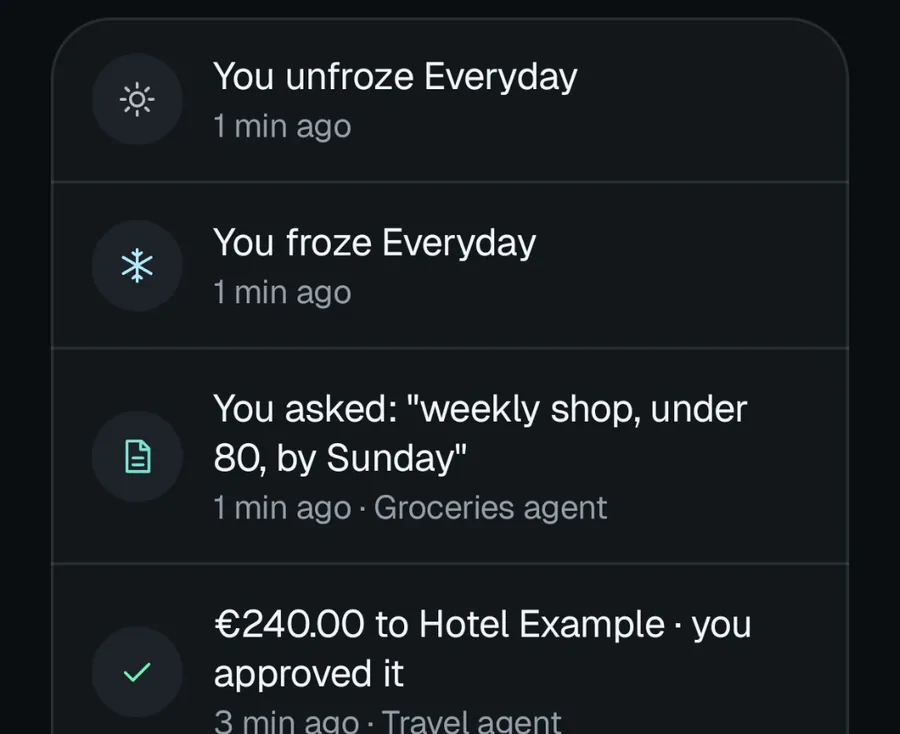
Set the lines once, in plain choices. Read every event as a sentence. One hold stops every agent.
Integrate once and work with every conformant bank. An agent reads what remains before it buys, and each refusal gives it a code to act on. The same request key never pays twice.
Embed the framework inside the perimeter, connect four systems and keep every regulated activity. No shop has to change.
Gate one runs when the agent asks for a number, and it has full context. Gate two runs when the shop asks for money, and it has only what a card authorization carries.
A rich check where the data is rich, a narrow check where the data is thin.
The agent asks for a number. Gate one checks the task, the category, the caps and the balance, always in that order.
The number works at one shop, up to one ceiling, for a short time. No task means no number.
The shop asks for money. Gate two checks the number, the shop and the amount. A wrong shop or a high amount burns the number.
The first failure wins, and it returns exactly one reason. Without a fixed order, two banks could answer the same refused request with different codes, and an agent that branches on the code would behave differently between them.
A vague decline is right for people. For a machine it is waste, because the machine retries blindly or gives up. So the reason goes to the agent and the owner, and the shop learns nothing.
SHOP_MISMATCH
The number is burned. Ask for a new one.
a gift card site tried 50.00 · gift cards are off by default · number burned
Declined
An ordinary decline, with no reason.


Caps, categories and an ask line, in plain choices. The bank enforces them on every payment.
Each card has its own shop and its own ceiling. Add more cards at any time.
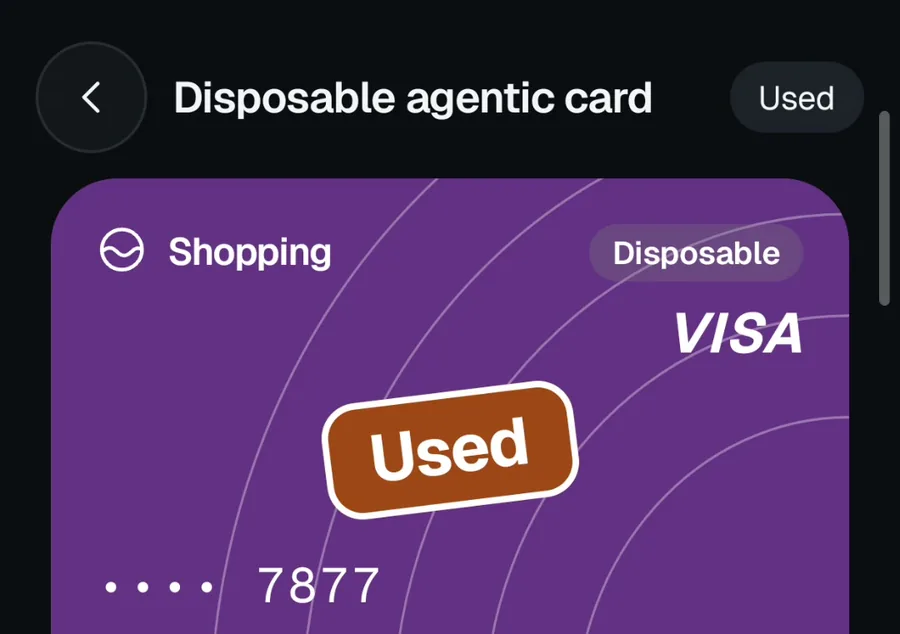
A leaked number is worth nothing.
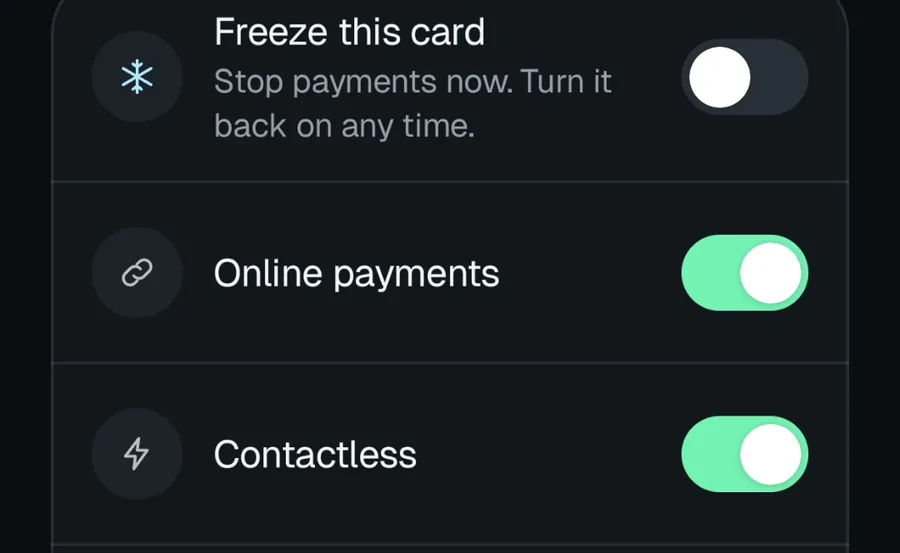
Stop a card now, and turn it back on later.
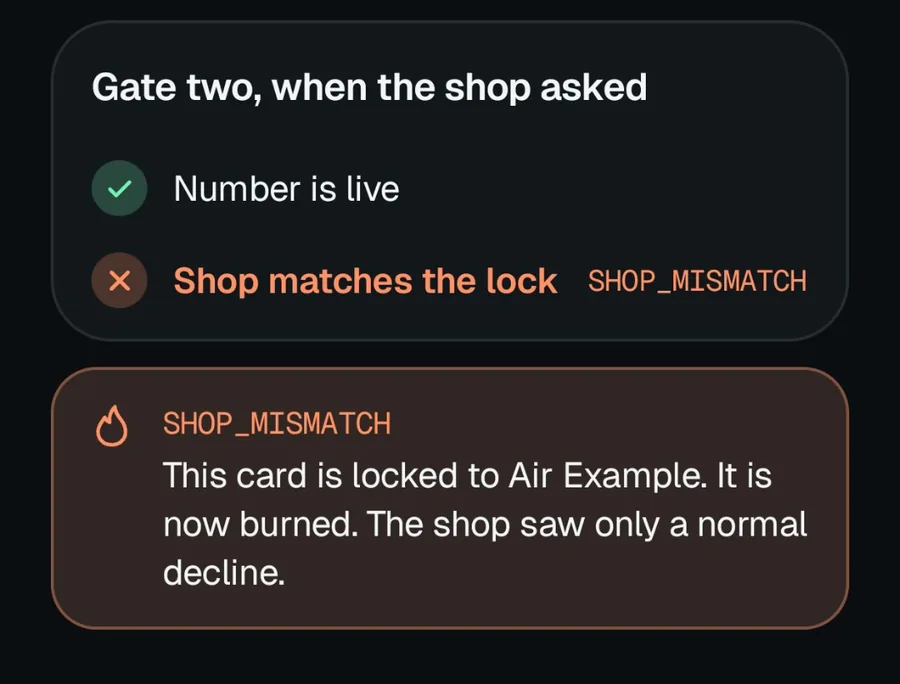
The shop sees only a normal decline. The agent and the owner see the reason.
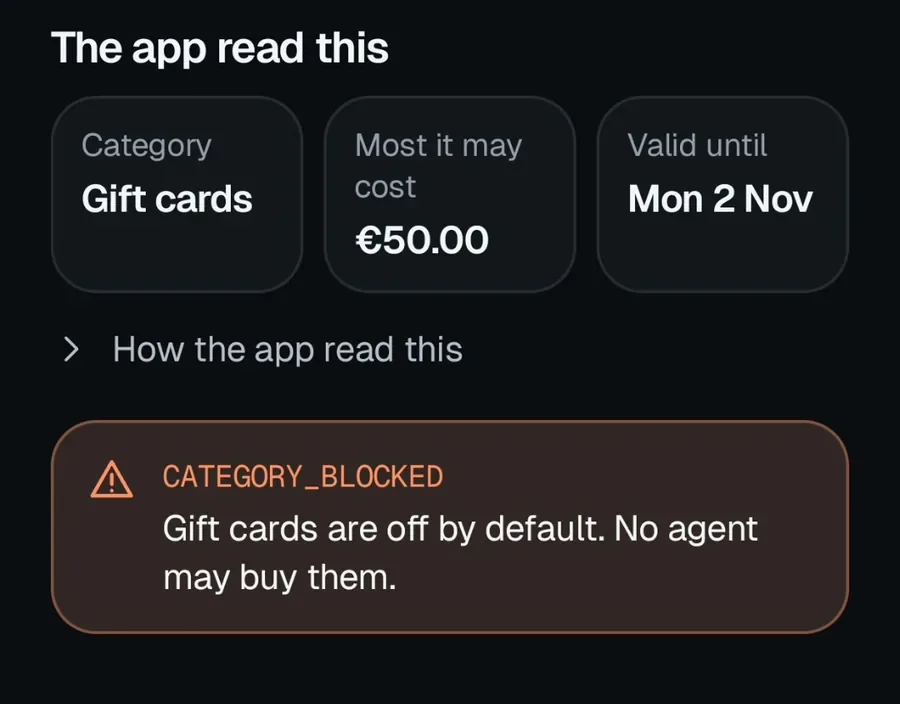
Gift cards, money transfers and crypto on-ramps are off by default.
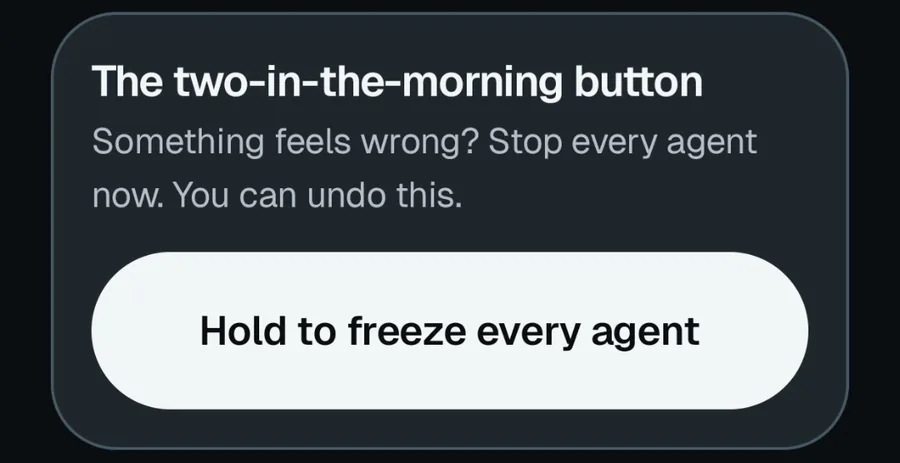
One hold freezes every agent. You can undo it.
Consent the owner cannot read is not consent.
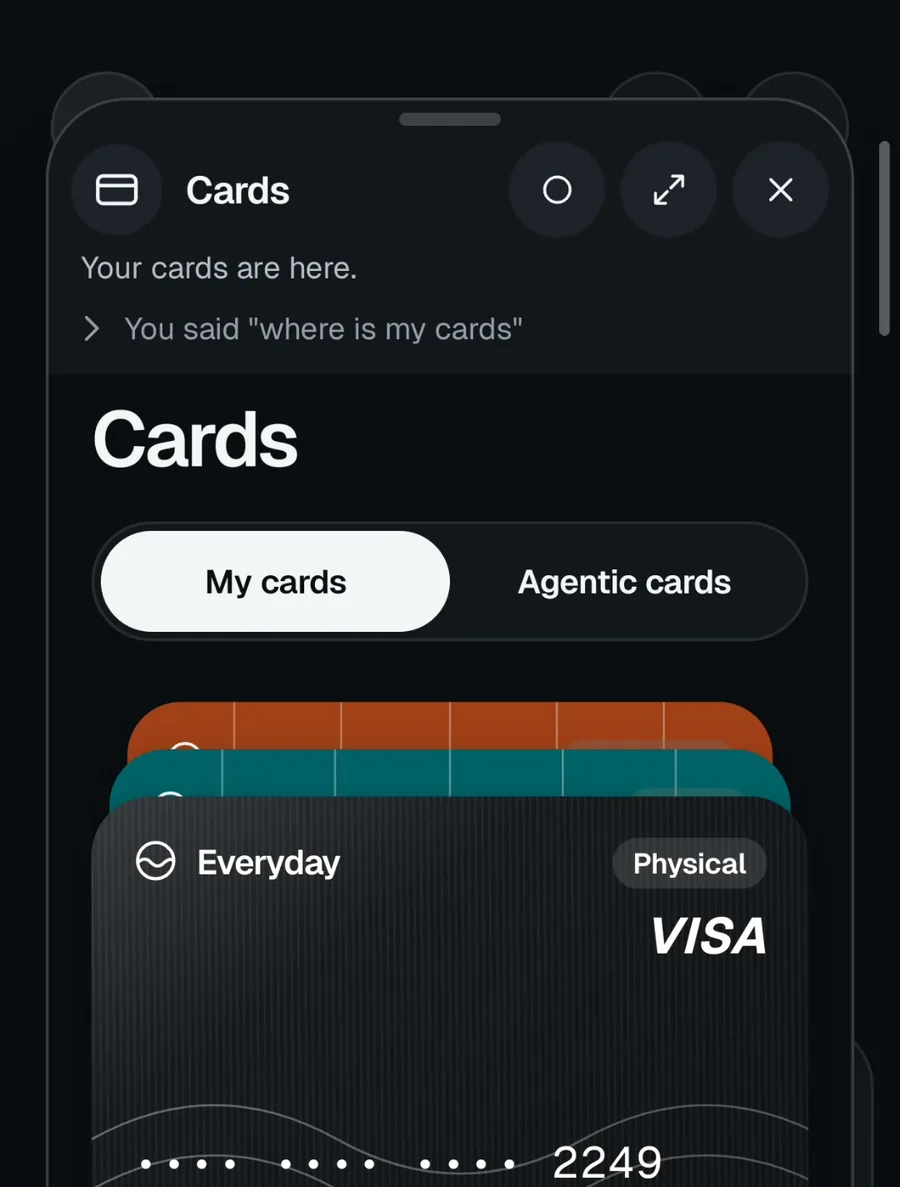
The assistant opens the place in a floating tab. It cannot move money.
The Trust tab shows how the app is built, how it protects you, and the rules its AI follows. It rests on the three pillars of the SEE framework.
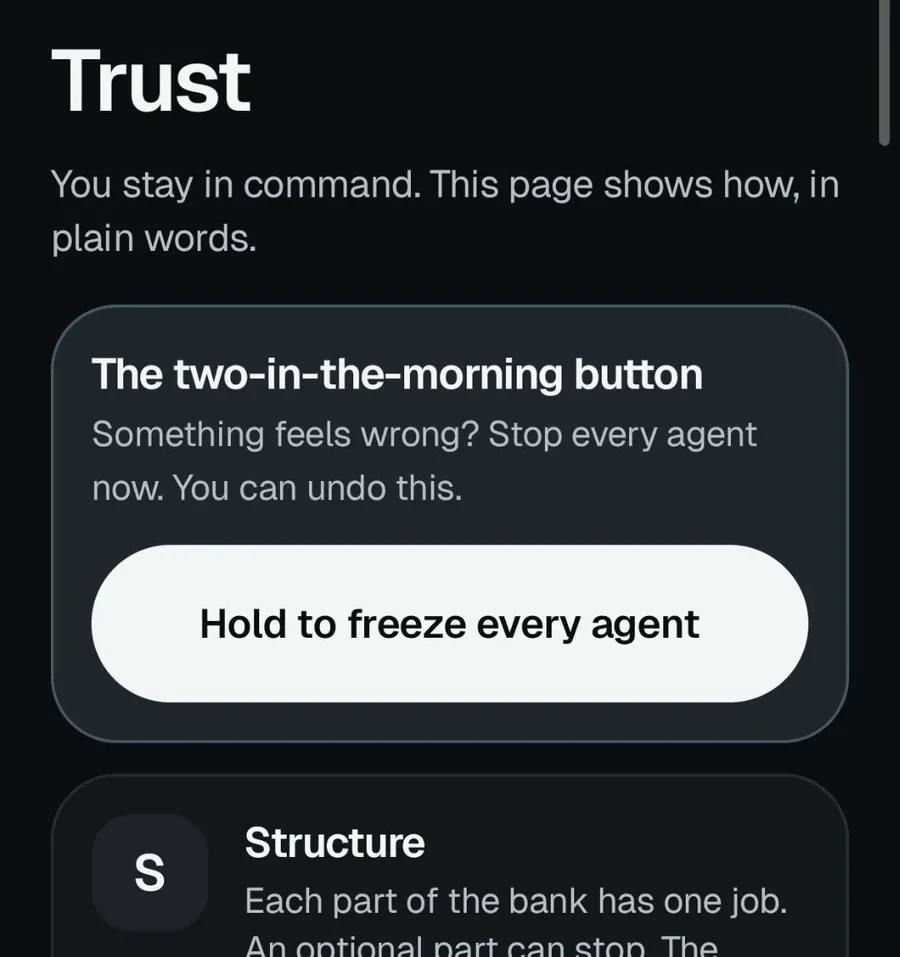
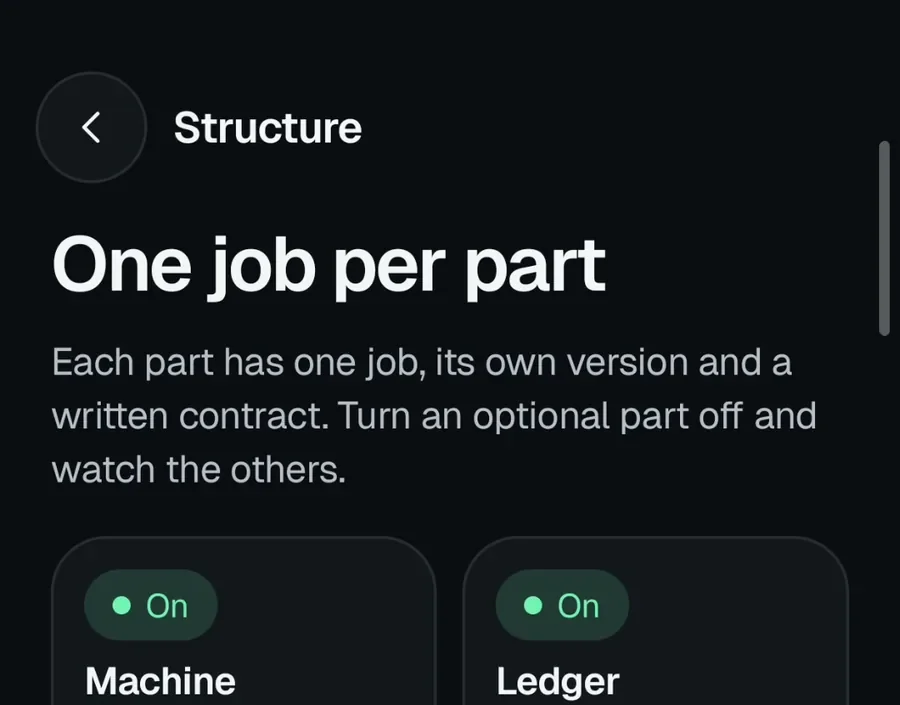
Every part has one job and speaks through one versioned contract. An optional part can stop, and the others keep working.
Sealed files, signed agent requests and an append-only log with a hash chain. Verify now checks every line.
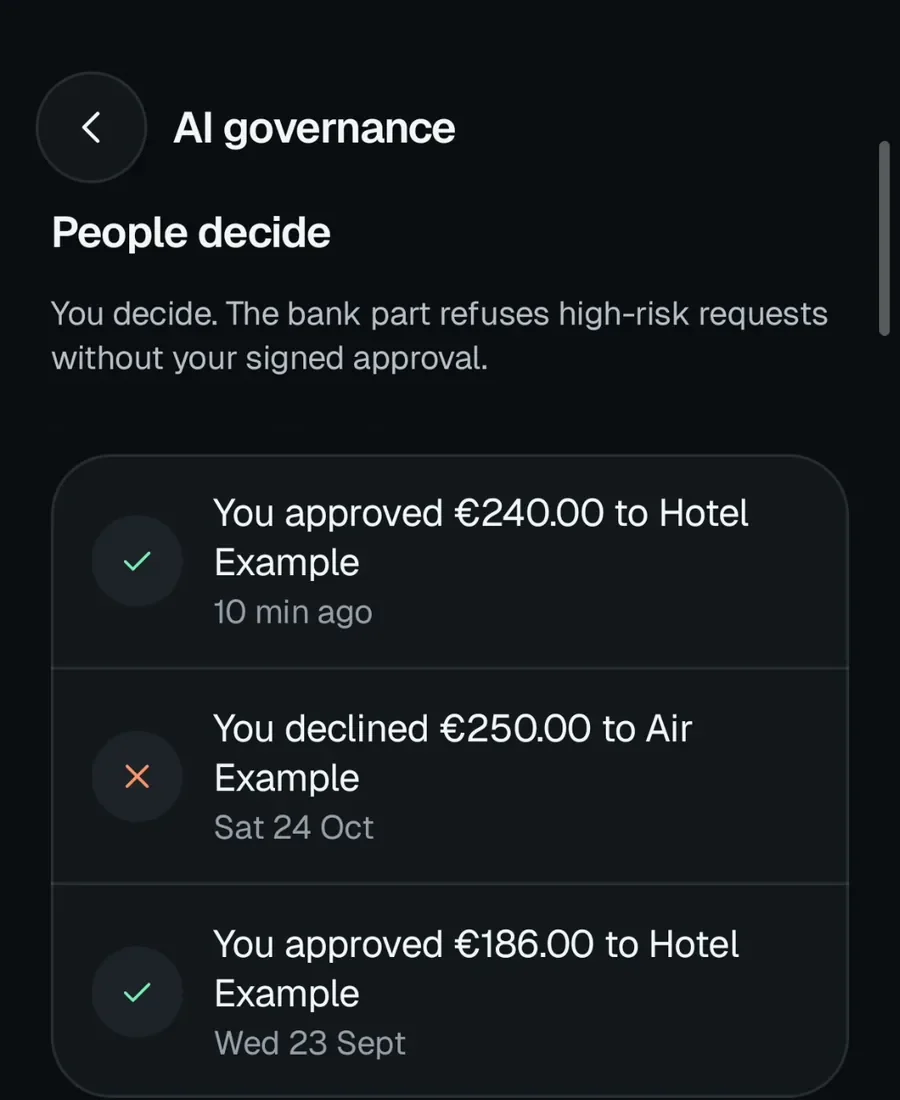
A refused list runs first, each voice decision keeps a record, and people decide every high-risk action.
paths from an agent's pot to your main account
key for each agent. A new key kills the old one, and only the old key can install a routine new one.
is the most a signed request may be off the clock. A repeated nonce fails too.
purposes for your task records: authorizing payments and evidencing disputes. No marketing, profiling, credit decisions or sale.
A bank writes no policy engine, no reason codes and no order of checks. Those arrive ready.
Level 1 uses parts a bank already has. Neither level needs a shop to change anything.
Limits, expiry windows, branding and transport stay the bank's choice.
It stops at the payment. Refunds, returns and disputes travel the bank's existing card rails and processes, exactly as they do today.
The framework makes payment available to a machine, under rules a person set and can read, and it does nothing on anyone's behalf afterwards.
A framework that a bank embeds. It gives each AI agent a small, rule-bound account under its owner's name, and it decides every payment at two gates. The bank keeps the money, the customer and every regulated activity.
No. The pot has no path to the main account, because the framework has no operation that could reach it. Money enters the pot only when the owner moves it.
A wrong shop or an amount above the ceiling burns the number at once, and a burned number never works again. A used disposable number is already dead, so a breached shop database holds nothing of value.
The pot opens under an existing bank customer, so the agent takes that person's checked identity. No new onboarding happens, and that person sets every rule.
The bank, in its own ledger. The framework runs inside the bank, and it never holds or moves money.
It gets a reason code and the data to act on it, such as the cap and what remains. The shop gets a normal blank decline and learns nothing.
The payment waits until its time limit, two hours by default, then declines by itself. The money moves only after the owner's hold.
Task records have exactly two purposes: authorizing payments and evidencing disputes. They are not for marketing, profiling, credit decisions or sale, and the bank keeps them no longer than the dispute window.
No. The assistant opens places and answers questions. It refuses a request to read a card number, and it has no way to approve or send a payment.
No. The framework needs no change at the shop. The checks run at the bank, on the card number that the shop presents.
Not yet. This page shows a demonstration with test money, test cards and simulated shops. No licensed bank, card issuer or Visa product offers it today.